Showing posts with label power. Show all posts

Thursday, November 20, 2014

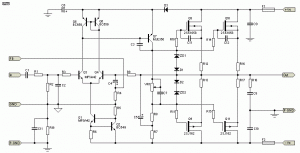
High HiFi Power Amplifier with MOSFET

Circuit amplifier "High Power HiFi Power Amplifier With MOSFET" is capable of giving the output power to the load speakers 240Watt and 380Watt 8Ohm to load 4Ohm speakers.

Voltage source to a series of power amplifiers "High Power HiFi Power Amplifier With MOSFET" This is a CT 25V 50V 25V to 50V CT of transformer CT. In making this power amplifier needs to be installed heatsinks on the power amplifier (MOSFET) in order to avoid excessive heat. The series of power supply to power amplifer can use the transformer 5A-20A and 35A mounted diode bridge and capacitors for a minimum of 2x 10.000uF electrolit. Details for the power amplifier circuit can be seen in the following figure.


High

High Power Series HiFi Power Amplifier With MOSFET can modify to increase power output by doubling the final power amplifier is based on the diiginkan. Power generated from doubling the final power amplifier will also double its power output of power amplifier circuit "High Power HiFi Power Amplifier With MOSFET" it.
Read More..

Wednesday, November 19, 2014

Odd Block KT88 Series 1 Tube Amp Power Supply

OddOdd Block KT88 Series 1 Tube Amp-Power Supply

A schematic of the ability accumulation is apparent below. Like the amplifier schematic, the ability accumulation ambit is © OddWatt Audio and permission to host the schematic on this armpit has been provided by OddWatt Audio. You are chargeless to use the schematic for personal, non-commercial use.

Mains ability enters the amplifier through an IEC atrium amid at the rear of the amp. The IEC atrium includes a 3 Ampere agglutinate and an EMI filter. The ability agent is an OEM bogus by Edcor with ratings of 180V-0-180V at 250 mA and 12V at 4A. Ability accumulation capacitors are Panasonic ECG alternation 500 volt electrolytic and Solen Polypropyene. The ample ability resistors are Vishay/Dale wire anguish and the actual resistors are carbon film. The High-Tension (HT) accumulation is rectified with STTH5 ultrafast aerial voltage rectifiers and uses CRC filtering. A 12V DC accumulation is acclimated for the tube heaters. An adjustable adjournment ambit is acclimated to adjournment the HT accumulation on ability up.

Read More..

Tuesday, November 18, 2014

10A High Current variable power supply

Power supply has 10A maximum current and output voltage can be set from 2 - 36VDC. Power supply circuit is quite simple, which is composed of the rectifier, voltage regulator and power regulator. Power regulator circuit High Current Variable Power Supply 10A uses the Q3 and Q4 are arranged Darlington and serves as a power regulator drivers Q5 and Q6. While the voltage regulator circuit is VR1 which serves as a variable voltage divider and Q1 and Q2 are arranged as a controller driver Darlington power regulator with variable reference voltage divider VR1.
10A

In a series of High Current Variable Power Supply 10A 10A above have been completed as a current-limiting fuse. and to monitor the current flowing with ampere meter and volt meter to monitor the output voltage of the circuit.
Read More..

Monday, November 17, 2014

5 Volt Switching Regulator Power Supply

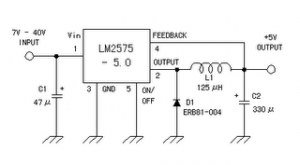
The switching regulator power supply used LM2575-5.0 on this schematic. You can make the stable voltage by using the 3 terminal regulator like LM317. However, because the output electric current and the inputted electric current are the same approximately, the difference between the input electric power (The input voltage x The input electric current) and the output power (The output voltage x The output current) is consumed as the heat with the regulator. Because it is, the efficiency isn't good. 5

Data sheet for LM2575
SIMPLE SWITCHER 1A Step-Down Voltage Regulator
http://www.national.com/pf/LM/LM2575.htm
Read More..

Friday, November 14, 2014

5V DC POWER SUPPLY

This is simple way to power some 5v logic from a 240vac source. If a 120vac power adapter is used, the circuit will also work for 120vac power lines.

Schematic
Read More..

Saturday, November 8, 2014

Guitar Effect Pedal Power


A small box is fitted to the rear of the amplifier providing a 9V output for the effect pedal. The amplifier section gets 9V through a pedal switch. This power output and guitar signal input lines are combined into a single unit with multi-way cable connecting points as shown in the following figure. 
Guitar Effect Pedal Power diagram :

Guitar Effect Pedal Power Circuit Diagram
The circuit can be divided into two sections: power supply and signal handling. The power supply section is built around transformer X1, regulators 7805 and 7905, bridge rectifier comprising diodes D1 through D4, and a few discrete components. The signal-handling circuit is built around two OP27 op-amps (IC3 and IC4). The power supply of about 9V for the effect pedals is derived from step-down transformer X1. MOV1 is a metal-oxide varistor that absorbs any large spike in mains power.  IC 7905 (IC1) is a -5V low-power regulator. By using a 3.9V zener diode (ZD1) at its ground terminal, you get -8.9V output. The same technique is also applied to IC 7805 (IC2)-a +5V regulator to get 8.9V. Use good-quality components and heat-sinks for the regulators. This supply is more than enough for the five effect pedals.
The greater the voltage drop across the regulator, the lower the output current potential. Resistors R1 and R2 provide a constant load to ensure that the regulators keep regulating. Capacitors C3 through C8 ensure that the supplies are as clean as possible. It is very important to use proper heat-sinks for IC1 and IC2. Otherwise, these could heat up.

Working of the circuit is simple. The input signal stage uses a basic differentiation amplifier to accept the incoming signal and a voltage follower to buffer the output to the power amplifier. The differential amplifier is built around IC3. It works by effectively looking at the signals presented to its inputs. If the input signals are of different amplitudes, IC3 amplifies the difference by a factor determined by R4/R3 (where R4=R6 and R3=R5). If the input signals have same amplitudes, these are attenuated by the common-mode rejection ratio (CMRR) of the circuit. The value of CMRR is determined by the choice of the op-amp the auxiliary components used and circuit topology. You can use standard resistors.

With the values shown, you get an overall gain of unity. 
The combination of resistor R7 and C13 serves as a passive low-pass filter, progressively attenuating unwanted high-frequency signals. The second op-amp (IC4) forms a simple voltage follower (its output follows its input), providing a low output impedance to drive into the standard power amplifier.  Assemble the circuit on a general-purpose PCB and fit it to the rear of an amplifier. The unit must be compact, yet robust. So use a very sturdy aluminium extrusion for the cabinet in order to neatly house the assembled PCB.
To ensure simple operation, there are only three connections to the unit. First, mains power is tapped from the transformer. The second lead carries the 9V output to the amplifier. The third is the guitar signal input at the five-way socket for connection to the effect pedal.
Read More..

Friday, November 7, 2014

50 W Power Amplifier Circuit using STK084

50W

This is the circuit diagram of 50W power amplifier circuit which built based on single power amplifier chip of STK084. Its an well-known old IC for audio frequency (AF) amplifier.

This circuit requires dual polarity / split power supply with maximum supply of ± 50. The recommended supply is ± 35 / 2-3A DC current. You may use this split power supply circuit for the amplifier. Use 28V center tap transformer to get about ± 36V output.

Technical Details:
Power output: 50W
RL : 8 Ohm
TDH : 0.2 %
Rin : 52K
Gain : 26.4 dB
Noise : 0.3 mV

Take a note that heatsink is required to be mounted on the power IC since it will going to hot when operated and deliver high power output (high audio volume level).
Read More..

Wednesday, November 5, 2014

High Voltage 3 Watt Audio Power Amplifier

The LM4954 is an audio power amplifier primarily designed for demanding applications in mobile phones and other portable communication device applications. It is capable of delivering 2.4 Watts of continuous average power to an 8 BTL load with less than 1% THD+N from a 7VDC power supply. Boomer audio power amplifiers are designed specifically to provide high quality output power with a minimal number of external components. The LM4954 does not require output coupling capacitors or bootstrap capacitors, and therefore is ideally suited for lower-power portable applications where minimal space and power consumption are primary requirements.

High Voltage 3 Watt Audio Power Amplifier Circuit Diagram
Amplifier

The LM4954 features a low-power consumption global shutdown mode which is achieved by driving the shutdown pin with logic low. Additionally, the LM4954 features an internal thermal shutdown protection mechanism.
The LM4954 contains advanced pop & click circuitry which eliminates noises that would otherwise occur during turn-on and turn-off transitions.
The LM4954 is unity-gain stable and can be configured by external gain-setting resistors.

Key Specification
Wide Power Supply Voltage Range 2.7 <= VDD <= 9V
Output Power: VDD = 7V, 1% THD+N 2.4W (typ)
Quiescent power supply current 3mA (typ)
PSRR: VDD = 5V and 3V at 217Hz 80dB (typ)
Shutdown power supply current 0.01µA (typ)

Features:

  • No output coupling capacitors, snubber networks or bootstrap capacitors required
  • Unity gain stable
  • Externally configurable gain
  • Ultra low current active low shutdown mode
  • BTL output can drive capacitive loads up to 100pF
  • "Click and pop" suppression circuitry
  • 2.7V - 9.0V operation
  • Available in space-saving microSMD package
  • Applications

  • Mobile Phones
  • PDAs


  • Read More..

    Sunday, November 2, 2014

    2×25W Stereo Power Amplifier with STK4141II

    2×25W Stereo Power Amplifier with STK4141II

    Here the stereo power amplifier based on single IC STK4141II. This amplifier circuit will deliver 25W on each output channel.
    Recommended voltage is 27.5V for 8ohms speaker and 24.5V for 4ohms speaker while the maximum voltage to supply this circuit should be about 41 VDC.

    Heatsink usage on the power IC is a must.

    Use this STK4141II Datasheet for your reference.  
    Read More..

    Thursday, October 30, 2014

    Mini Stereo Power Amplifier using TDA2822

    This circuit TDA2822 total to the same extent your primary device. The Dual Amplifier IC before IC stereo increase by 40 dB. Bandwidth 120 kHZ. with the purpose of is regarding 2 watts and watt power supply of 1.8 to 15 volts and a current 6 mA no more than after using the power supply 9 volt into this circuit.VR1 and VR2 to adjust the suggest level of the best and not here, the pin 7 and pin 6 of IC1.The amplifier IC1 is outmoded of the output pin 1 and pin 3, through the C4 and C5 coupling signals to the absent and right speakers.The C6, R1 and C7, R2 is to reduce blast.

    Mini
    Mini Stereo Power Amplifier using TDA2822 Circuit Diagram

    Read More..

    Tuesday, October 28, 2014

    Mini 2x75W Stereo Power Amplifier

    Your search for audio power amplifier with 75W stereo power with a slim body, you can use this  Pyle - Mini 2x75W Stereo Power Amplifier - PCA3 . Power amp is designed simply and easily be placed anywhere, not just a good amplifier design is also very good in terms of sound quality in its gain. You can use this amplifier with a media player with a voice like VCD, DVD, Tape, etc.. What are you waiting you can buy the amplifier via the link below :
    Pyle - Mini 2x75W Stereo Power Amplifier - PCA3
    Read More..

    Monday, October 27, 2014

    TDA2030 bridge 35 watt power amplifier Diagram Circuit


    A very simple 35 watt power amplifier electronic project can be designed using the TDA2030 power audio IC. The TDA2030A is a monolithic IC in Pentawatt package intended for use as low frequency class AB amplifier.
    The TDA2030A provides high output current and has very low harmonic and cross-over distortion. TDA2030 ICs connected in bridge mode.
    This circuit require few external electronics parts and supports a 8 ohms load . This 35 watt power amplifier require a very good filtered DC power supply , that will provide an output voltage of +/- 16 volts .

    Using this circuit you can design a very simple and efficiency subwoofer amplifier with a maximum output power of 35 watt power .
    The device incorporates a short circuit protection system comprising an arrangement for automatically limiting the dissipated power so as to keep the working point of the output transistors within their safe operating area. Also a conventional thermal shut-down system is also included .
    However a heatsink must be used for the TDA2030 bridge circuit but for any reason, if the junction temperature increases up to 150oC, the thermal shut-down simply reduces the power dissipation and the current consumption.

    Read More..

    Thursday, October 23, 2014

    Tube Power Amplifier 35W Push Pull

    Tube Power Amplifier 35W Push Pull is made using a tube and eventually compiled configuration push-pull amplifier. Tube Power Amplifier 35W Push Pull tube til it using EL-34 as the amplifier end.
    In the power amplifier that is made with a tube at a glance looks simple because the use of active components that are not complex. It should be noted that the use of tubes in Tube Power Amplifier 35W Push Pull require a high voltage supply, therefore in the process of making and finishing must be careful of high voltage and radiation. Detailed series of Tube Power Amplifier 35W Push Pull can be seen in the following figure.

    Tube Power Amplifier Series 35W Push Pull

    Sign Components Tube Power Amplifier 35W Push Pull
    R1 = 470K 0.5 W
    R2-5 = 2K2 0.5W
    R3 = 150K 0.5W
    R4 = 220K 0.5W
    R6-10 = 56K 0.5W
    R7 = 3.9K 0.5W
    R8 = 220R 0.5W
    R9 = 1M 0.5W
    R11 = 39K 1W
    R12-23 = 180K 0.5W
    R13-21 = 820K 0.5W
    R14-22 = 5K6 0.5W
    R15-20 = 680K 0.5W
    R16-19 = 100K 0.5W
    R17-18 = 3K3 1W
    R24 = 470R 2W
    TR1-2 = 470R 1W Variable (adj. 270Ω)
    C1-3-6-7 = 0.1uf 630V
    C2 = 220pF 600v
    C4-5 = 16uF 550V
    C8-9 = 0.1uF 630V
    C10-14 = 0.47uF 630V
    C11-13 = 25uF 40V
    V1 = E80CC
    V2 = E80CC
    V3-4 = EL34
    Rectifier tube = Z2C
    Audio Transformer for T1 = 2x EL34 Push Pull
    Power amplifier with tubes often become the choice for a small slewrate so that the resulting audio quality is guaranteed. Tube Power Amplifier 35W in the circuit that is required to supply a high DC voltage is +220 VDC ddengan order to work properly.
    Read More..

    Saturday, October 18, 2014

    2N3055 UA723 Power Supply Adjustable 0 30V 2A


    It is a simple circuit regulated power supply, based on the known UA723, that drive a transistor Q1 [2N3055]. The regulation of voltage, of expense becomes with potentiometer R1 from 0v-30v DC roughly. In order to we achieve 30 V, will should the transformer of supply TR1, it gives all the current that it asks the load, differently the output voltage it will be found in the levels of 26 V roughly. Essential is the use of a good heatsink for transistor Q1, as well as good quality of potentiometer in the place of R1.

    Source:http://users.otenet.gr/~athsam/power_supply_30.htm
    Read More..

    Friday, October 17, 2014

    7 Watt Audio Power Amplifier Circuit Schematic

    This small amplifier is constructed around the TDA2003 IC, capable of delivering 4Wrms at 4ohms. The TDA 2003 has improved performance with the same pin configuration as the TDA 2002. The additional features of TDA 2002, very low number of external components, ease of assembly, space and cost saving, are maintained. The device provides a high output current capability (up to 3.5A) very low harmonic
    and cross-over distortion. Completely safe operation is guaranteed due to protection against DC and AC short circuit between all pins and ground, thermal over-range, load dump voltage surge up to 40V and fortuitous open ground. A conventional direct current can be connected as supply.


    Circuits picture:
     7 watt audio amplifier circuit schematic and circuit diagram
    Front View of 7 Watt Audio Power Amplifier


    Circuit diagram:
     7 watt audio amplifier circuit schematic and circuit diagram
    7 Watt Audio Power Amplifier Circuit Diagram


    Parts:

    R1 = 470R
    R2 = 47R
    R3 = 100R
    R4 = 1R
    C1 = 1822pF
    C2 = 100nF-63V
    C3 = 100nF-63v
    C4 = 10uF-25V
    C5 = 470uF-25V
    C6 = 1000uF-35v
    C7 = 1000uF-35V
    IC1 = TDA2003


    Specifications:
    • Music power output: 7W / 4ohm
    • RMS output: 3.5W / 4ohm or 2W / 8ohm
    • Total harmonic distortion: 0.05% (1W / 1kHz)
    • Frequency response: 20Hz to 20kHz (-3dB)
    • Signal/noise ratio: 86dB (A weighted)
    • Input sensitivity: 40mV / 150Kohm
    • Overload and short-circuit protected
    • Supply voltage: 15V DC (8 to 18V DC possible) / 0.5A
    • Dimensions: 2.2 x 1.4"
    Read More..

    25W Audio Power Amplifier Circuits Diagram

    This audio power amplifier project is based on LM1875 amplifier module from National Semiconductor. It can deliver up to 30W of power using an 8 ohm load & dual 30V DC power supplies. It is designed to operate with maximum outside parts with current limit & thermal shutdown protection features . Other features include high gain, quick slew rate, wide power supply range, giant output voltage swing & high current capability.

    Summary of the audio amply-fire features:

    • Low distortion: 0.015%, 1 kHz, 20 W
    • Wide power bandwidth: 70 kHz
    • Wide supply range 16V-60V
    • Up to 30 watts output power
    • Internal output protection diodes
    • Protection for AC & DC short circuits to ground
    • 94 dB ripple rejection
    • Plastic power package TO-220
    25V Power Supply

    The schematic below shows how the +25V DC & -25V DC are obtained. In order to provide power supply for two stereo amplifiers, a power transformer rating of 80VA with 240V/36V middle tapped secondary winding is used. The secondary output of the transformer is rectified by using 1N5401 diodes together with four electrolytic capacitors to smoother the ripple voltage. A fuse & a varistor are connected at the primary input to protect the circuit against power surge.

    25W


    Audio Amplifier Module

    The +25V & -25V DC power supply are connected to the audio amplifier module through a 2A fuse with the peripheral devices shown in the schematic below. The audio input signal to be amplified is coupled to pin one of LM1875 through the resistor R1 and electrolytic capacitor E5.

    The output signal at pin four of LM1875 can be used to directly drive a 8 ohm loudspeaker. Resistor R6 and capacitor C5 prevent-the capacitance developed at the long speaker leads from driving the amplifier in to High Frequency Oscillation.

    A heat-sink with a thermal resistance rating of one.4 Cecilius/Watt or better must be used or else the amplifier module will-be cut-off from operation due to the heat that will build up in the coursework of the operation of the amplifier. Take note that the heat sink tab on the IC module is internally connected to the -25V power supply hence it must be isolated from the heat sink by the use of an insulating washer. If this is not done, the negative rail will be shorted to ground.

    25W


    Read More..

    Monday, October 13, 2014

    STA575 200 watt stereo power audio amplifier circuit

    This power audio amplifier electronic project is based on the STA575 fully integrated power module designed to implement a BASH® amplifier when used in conjunction with STABP01 digital processor. This power audio amplifier electronic project is based on the STA575 is capable to provide a maximum 100 watts output continuous power per channel ( on two channels ) on a 4 or 8 ohms load . The circuit contains all the blocks to build a stereo amplifier. Each single channel is based on the Output Bridge Power Amplifier, and its protection circuit.

    STA575 power audio amplifier can be set in three states by the Stby/mute pin: Standby ( Vpin <0.8v), mute (1.6v 4V).
    In the Standby mode all the circuits involved in the signal path are in off condition, instead in Mute mode the circuits are biased but the Speakers Outputs are forced to ground potential.
    These voltages can be get by the external RC network connected to Stby/Mute pin.
    The same block is used to force quickly the I.C. In standby mode or in mute mode when the I.C. dangerous condition has been detected.
    The protection of STA575 power audio amplifier are implemented by the Over Temperature, Unbalance .
    The Output bridge amplifier makes the single-ended to Differential conversion of the Audio signal using two power amplifiers, one in non-inverting configuration with gain equal to 2 and the other in inverting configuration with unity gain.
    STA575

    To protect the output transistors of the power bridge a power detector is implemented .
    To power this 200 watt stereo power audio amplifier you’ll need a DC power source that will provide the following output voltages : Vs+ = 28V, Vs- = -23V, VCD+ = 20V, VCD- = -20V and you’ll need a 8 ohms load .
    In the table bellow you can see values for electronic parts required by this 200 watt stereo power audio amplifier electronic project .
    Read More..

    Sunday, October 5, 2014

    2N3055 using ic 5 Volt Linear power supply regulator


    This is 5 Volt Linear power supply regulator circuit. It uses electronics part that seek easily have no zener diode , and the integrated circuit use Transistor 2N3055 and other. Which seek easily use diode perform heal voltage be stable. By diode 1N914 number uses 1N4148 number can replace. For Transistor 2N3417 use the number BD139 equiv get. If use Transformer 1-2A circuit be this size give current get about 1 Amp. Friends may don’t be bored with line this circuit. I thinks it may advantage seek part easy and economize good yes.
    Read More..

    36V Output L200 Power Supply Circuit


    Description
    Power supply with variable voltage and fixed current regulation made using the ubiquitous L200C regulator.

    Notes
    The versatile 5 pin L200C regulator offers both voltage and current regulation in a single package. The IC also features thermal shutdown and input over voltage protection up to 60 Vdc. The package is also available as L200CV which has straight pins for mounting onto a PCB. The above circuit has current limiting of 1 amp, hence Rsc = 0.45 ohm. The output voltage is variable from 2.85V to 36V. For voltages up to 36V then the input voltage, Vcc must be 40V. The supply voltage must always a few volts higher than the maximum output voltage. If you wanted to make a 9 Volt current limited PSU then the input voltage should be a minimum of 12 Volts.

    Maximum Power Dissipation
    The L200 has internal limiting to reduce the amount of heat dissipation. This happens when the internal junction temperature reaches 150 °C. The datasheet has a graph of the safe operating area, but if drawing maximum output current of 2 amp, the input voltage minus output voltage difference must be less than 20 Volts.

    Specifications:
    DC Input Voltage: 40V max.
    Peak Input Voltage: 60V max. for 10ms
    Output Voltage Range: 2.85 to 36V
    Output Current Range: 0.1 to 2A
    Quiescent Current: 4.2mA
    Output Noise: 80uV

    The L200 regulator has many versions; L200, L200C, L200CH, L200CV. These are in fact all the same regulator. The main differences between variations are the thermal junction temperature and pinout.
    For the L200, the operating junction temperature is -55 to 150 °C
    The L200C operating junction temperature is -25 to 150 °C.
    The V stands for vertical and is the most common case style; available as a pentawatt package, shown right hand side. The H stands for horizontal and the pins of the L200 are bent at right angles for PCB mounting. The L200T and L200CT are also available but as a TO3-4 layout, this pinout can be seen in the datasheet, link below
    Read More..

    Friday, September 19, 2014

    LM317 Variable DC Power Supply

    LM317-Variable DC Power Supply Circuit diagram :

    This power supply is based on the LM317 Variable Regulator. The input of the regulator needs to be around 28 Volts DC and it will output a DC voltage from 1.25vdc to 25 vdc. To adjust the output voltage simply turn the 5k ohm pot. The regulator will supply 1.5 amps of current.

    Read More..